


Play brings people together – our philosophy
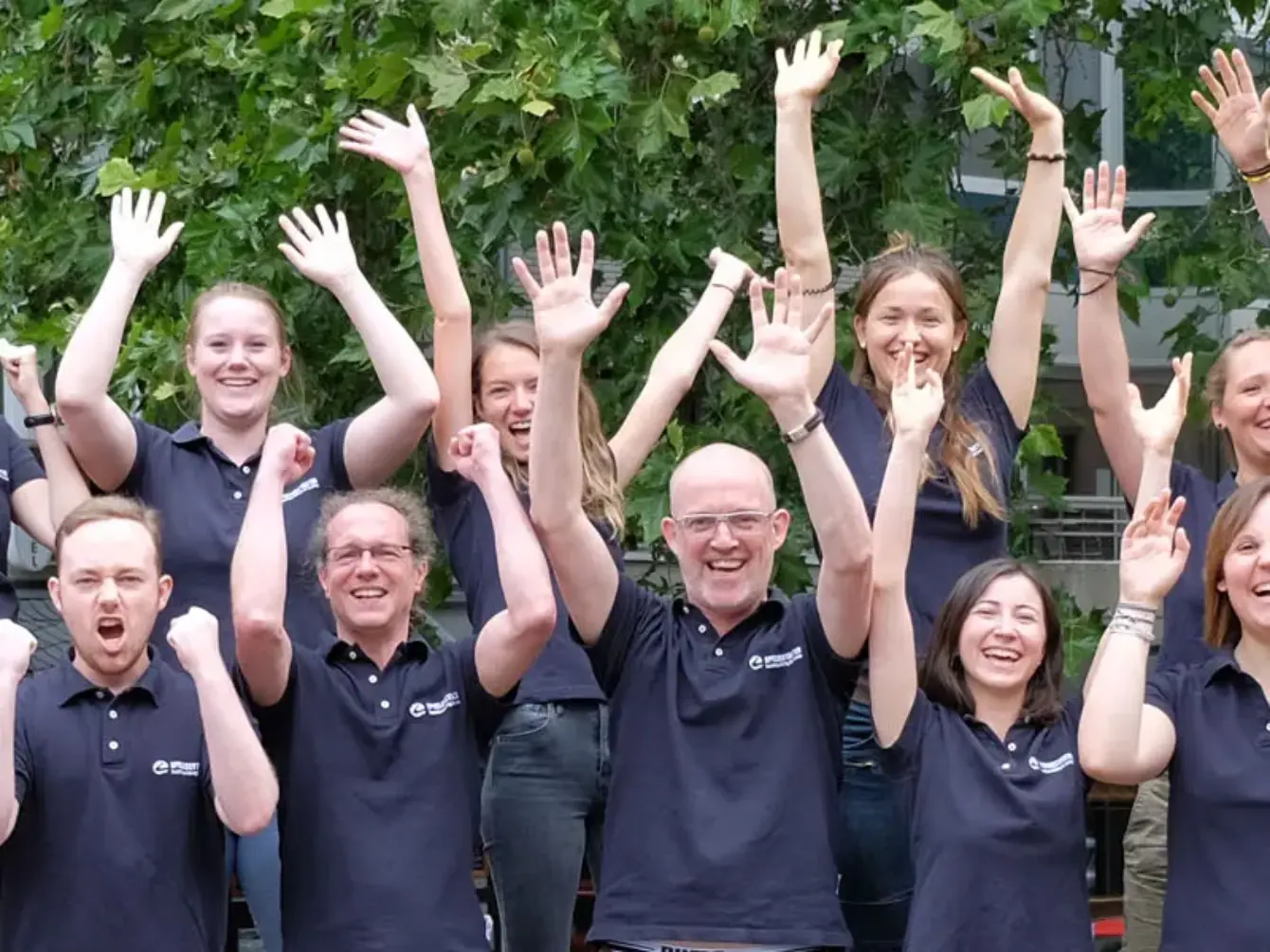
The best teams are formed where people laugh together, solve puzzles and push themselves to new heights. That is precisely the core of our work. Because play is more than just fun. It opens doors, breaks down barriers and creates genuine connections between people who may never have truly met before. It is this belief that gives rise to events that don’t just take place, but truly leave a lasting impact
How do teams bond particularly well?
Gamification – the game as a method!
Team events – more than just fun!
Team building, training, workshops – many management levels have come to realise that successful and regular team events have positive effects on the employee and team level, which have an impact on the company in various ways.
Low acceptance + low motivation = little effect
Employees often have reservations about team events: they are perhaps expecting boring workshops, ineffective training or team building make it feel like a waste of their time. Whether the reservations are based on experience or expectations is of secondary importance, as both lead to little acceptance and motivation. The employees “must” appear at the events. When employees “want” to participate, they’ll get a greater benefit as they are more motivated and are more amenable to change in the first place.
How to turn “have to” into “want to”.
One of the most efficient methods to increase motivation is the use of game elements, also known as “gamification”. In the specific case of team events, the use of game elements with a coherent game, leads to participants playing a game and learning subliminally – which create less resistance and a greater impact.

Gamification: Playing into the future?
Gamification is “the application of game-typical elements in a non-game context” (cf. also Unger, T. Gamification 2015, p. 190). A few concrete examples illustrate how it works:
- One of the largest international companies from the chemical and pharmaceutical industry has developed a software-based simulation game in which employees can train their managerial skills and get to know the widely ramified company with its sub-divisions.
- One of the world’s largest software manufacturers identified an important routine activity in its own work processes, but one that was boring for the employees and which was often postponed, thus holding up the work process. As an incentive, a computer-based skill game was designed and linked to this activity.
Both examples have successfully shown that gamification can increase motivation in certain activities. On the one hand, natural play instincts and curiosity are addressed, and on the other hand, the game mechanics used offer incentives to perform even unpopular activities.
In the meantime, it has also become apparent in the areas of health care, customer loyalty or knowledge transfer that embedded game principles can help to achieve goals more efficiently.
Gamification in team events
The team game
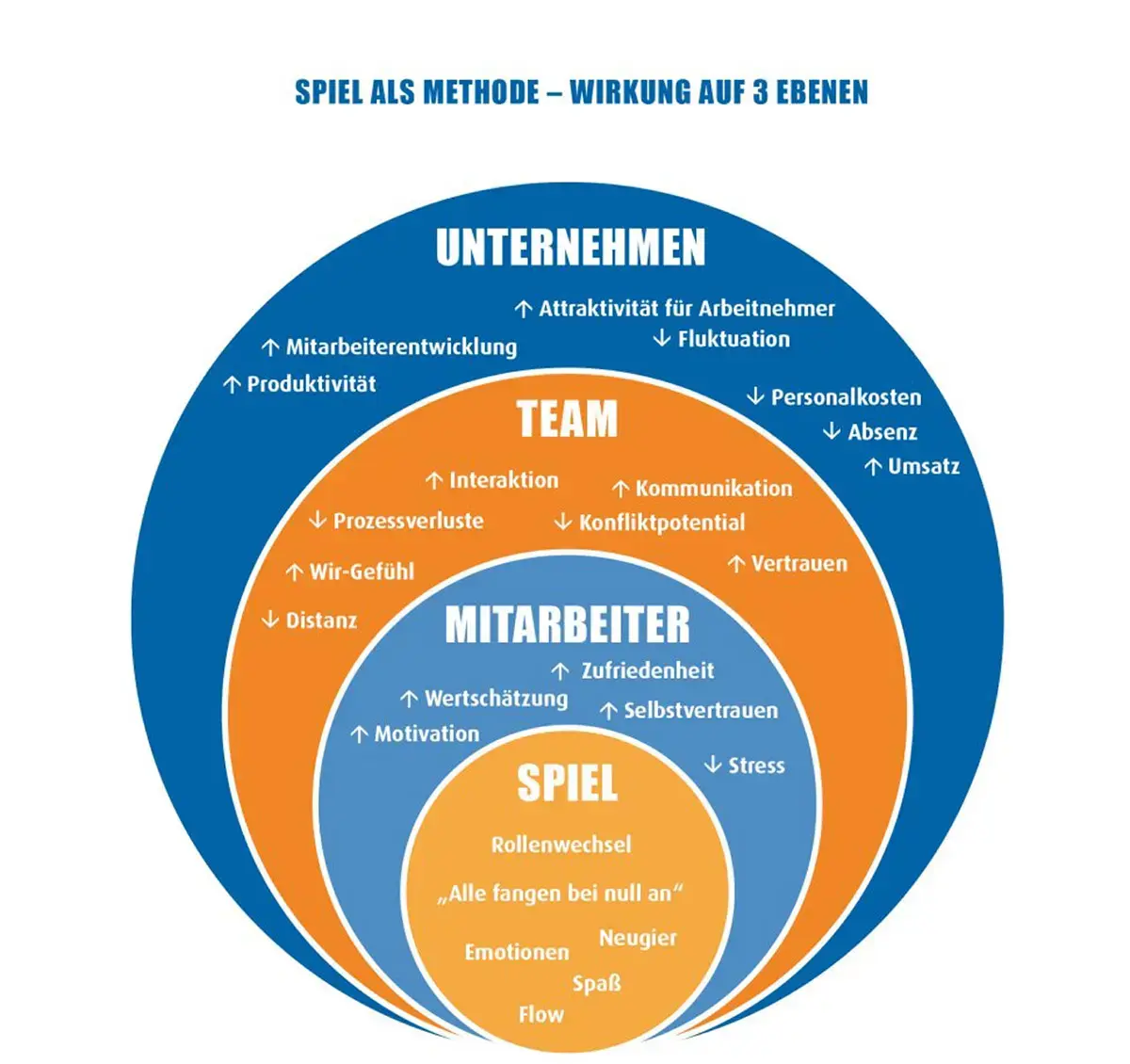
Up to now, the scientific consideration and evaluation of gamification has concentrated on the connection between work processes and learning successes of individuals. In the team game, there are additional positive aspects on different levels that can help to change the behaviour of individual employees and create better cooperation within the team:
The diagram illustrates the complex interaction of a wide variety of factors at the levels of the employee, the team and the company. Only exemplary descriptions are given here.
Would you like to learn more?
Please contact us:
+49 (0)221 – 283 263 0
mail@spielgestalter.de
Employee level
Sustainability
Through games that are fun and evoke positive emotions, the topics of the event can be anchored positively and sustainably. In addition, the game allows a deeper processing of learning content, because the content is experienced and experienced. This positive aspect was also known to Confucius:
“Tell me, and I will forget. Show it to me, and I may remember it. Let me do it, and I shall be able to do it.”
New talents are revealed
The game world has its own rules, coupled with the game mechanics, demands unusual and creative ways of finding solutions. It is not uncommon for these game situations to reveal hidden talents in the participants that they did not show in their everyday work, these hidden skills can be very helpful for the team. This can increase the employee’s self-confidence, as he or she becomes aware of the talent and accordingly expands his or her future action alternatives. Of course, the whole team can also benefit from this if the skills are needed in everyday work.
Team level
Role change for team chemistry
In a constructed game world, the same conditions apply to all participants, so everyone “starts at zero” – regardless of their position in the team. In this way, a change of roles can take place in the game setting and the supervisor can become a “playmate” – a perfect prerequisite for reducing distance and creating a good working atmosphere in the team.
Creative problem solving in the group
By using concise instructions, the self-determination of the group is promoted. In this way, gamification can be combined with the “experiential learning” approach. This learning approach focuses on experimenting and trying out new behaviours, which are transferred to everyday work after reflection. In addition, the groups are forced to communicate intensively and to leave their usual patterns of thinking. This promotes autonomous and creative problem solving in the team and thus also the self-confidence of the entire group.
Company level
Zufriedene Mitarbeiter – der Magnet für neue Talente
The days of the potential employee needing to be attractive to the company are coming to an end. Researchers predict a paradigm shift in the wake of demographic change (talent shortage): in the near future, it will be increasingly important to increase attractiveness as an employer in order to continue recruiting suitable personnel from the reduced supply of skilled workers. Employers will be rated on happiness of their staff, it is expected that these ratings will become an important evaluation criterion for future talents. Companies that are rated well on the evaluation portals by their satisfied employees will have better chances here. Team events that are fun for employees and are effective in enhancing staff skills will ensure you can secure the talents of the future.
Use team events that are fun for your employees and prevent prejudices from arising in the first place. We look forward to your enquiry.
- Christmas party ideas
- Company outing
- CSR Events
- Framework programs
- Indoor events
- Kick-off events
- Outdoor events
- Summer party
- Team building ideas
- Team day
- Team events
- Trainee events
- Virtual besteller
- Virtual christmas party
- Virtual events
- Virtual framework programs
- Virtual Kick off
- Virtual team building